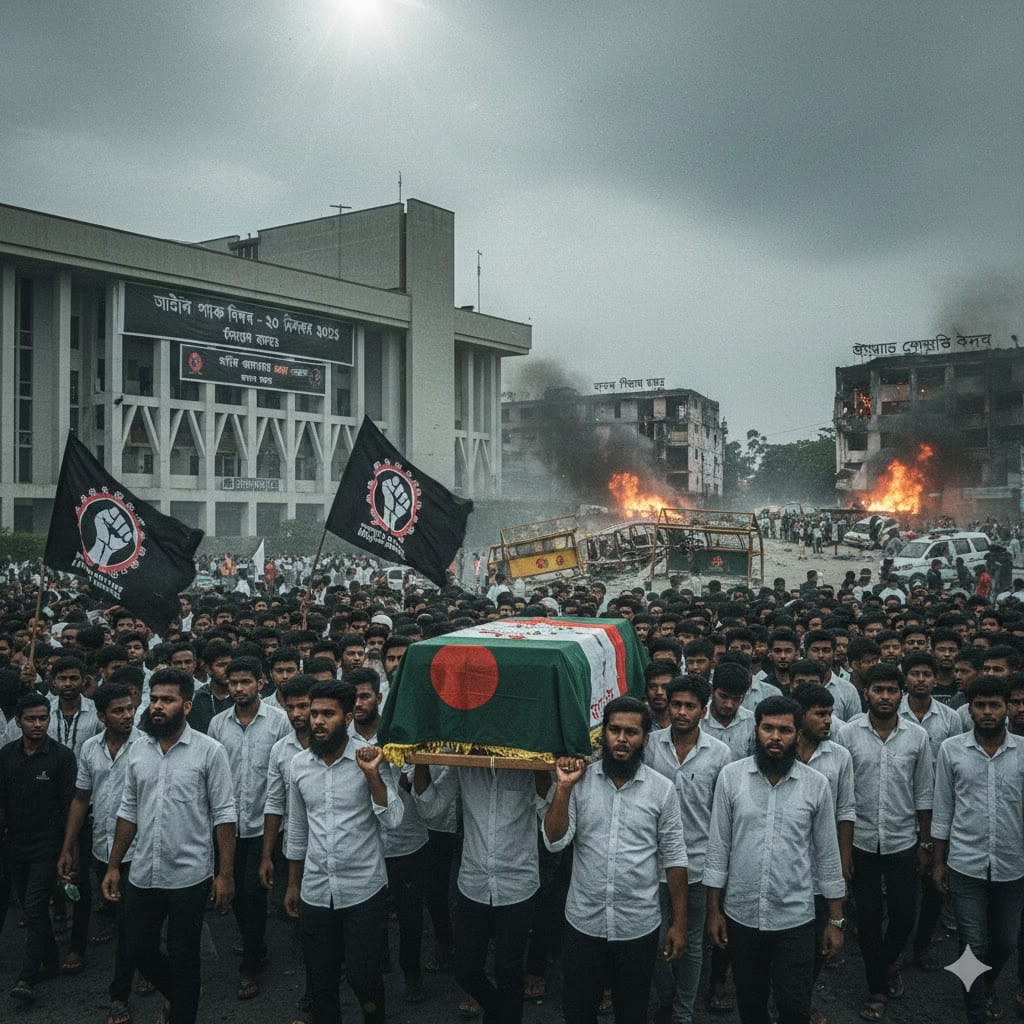

The death of Sharif Osman Hadi, the spokesperson for Inqilab Mancha, on December 18, 2025, represents a tectonic shift in the Bangladeshi state’s relationship with radicalism. Shot on December 12 during a campaign movement in Dhaka, Hadi died six days later in Singapore. This non-constitutional figure, who rose to prominence through street agitation rather than the ballot box, received an extraordinary honor from the interim government.
Chief Adviser Dr. Muhammad Yunus declared December 20 a “National Day of Mourning” and granted Hadi a funeral at the South Plaza of the Parliament—a venue typically reserved for the highest elected officials. This decision has effectively state-sponsored a radical, non-state ideology, signaling that “street legitimacy” now carries more weight than constitutional protocol.
This normalization of the fringe is the most dangerous development in the post-2024 era. Inqilab Mancha and its allies, like the National Citizen Party (NCP), represent a “Third pole” in Bangladeshi politics. They are not merely anti-Awami League; they are fundamentally anti-system, viewing the traditional political elites of the BNP and even the military with deep suspicion. This has created what analysts call the “Prison-to-Street” pipeline. During the August 2024 revolution, the mass escape of over 2,200 prisoners, including high-ranking militants, created a security vacuum that the state has failed to fill. With thousands of police weapons still missing from the August upheaval, the street now possesses the physical means to challenge the state’s monopoly on force.
The “Hadi Precedent” signals that the interim government is no longer just a caretaker; it is a hostage to the very forces it helped unleash. By aligning with radical youth groups to maintain a grip on power, the Yunus administration has created a feedback loop of violence. Over the last 48 hours, mobs in Dhaka have vandalized the offices of major media houses and attacked cultural institutions like Chhayanaut, labeling them as foreign agents. The state’s decision to declare mourning while these attacks occur suggests that the mob’s law has replaced the rule of law.
Historically, Bangladesh has been distinguished from Pakistan by its secular-linguistic identity, forged in the fires of the 1971 Language Movement. However, as of late 2025, that identity is being systematically dismantled. The destruction of Sufi shrines and the purging of cultural symbols are not random acts of hooliganism; they are a calculated effort to re-identify the nation. If the scheduled February 12, 2026, general election is held under these conditions, the result may not be a democratic transition but a formalized radicalization where the state apparatus is used to enforce a hardline social order. For the common Bangladeshi, this means the replacement of one form of autocracy with a more volatile, unpredictable anarchy of the righteous.
The elites may think they are using the mob, but history shows that the mob eventually consumes the elite.