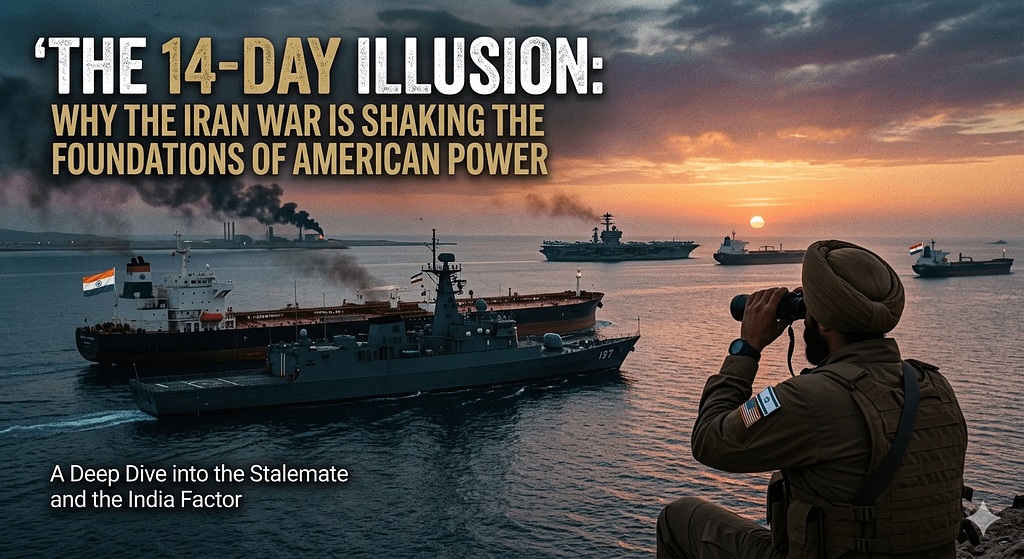

In a previous analysis on my webpage, titled The 14-Day Clock: A war of logistics not just fire power, I argued that Tehran’s only path to survival was to outlast the initial American onslaught. That clock has now run out. The “swift resolution” once promised by Washington has dissolved into the friction of a stretched and grueling war of attrition. When Donald Trump first announced a five-day pause on attacks, only to see it extended to ten, it wasn’t a show of strength; it was a loud admission that the initial plan had hit a wall. In the theater of modern conflict, credibility is the first casualty. Trump’s claims that Iran is “begging” for a deal ring as hollow as his past insistence that he had been asked to mediate between India and Pakistan—a claim India flatly and publicly rejected. If his diplomatic “wins” are often based on such rhetorical hallucinations, there is no reason to believe his current assessment of the battlefield.
The reason Iran is fighting so solidly, appearing to many as if it is actually winning, lies in the shifting nature of the conflict. A short, swift strike relies on “shock and awe” to force a collapse. Iran may have been in shock during the first two weeks, but once a war stretches, the psychological and logistical advantage shifts to the defender. Iran has reached deep into its arsenal to deploy innovative weapons that were previously only in the research phase—specifically passive tracking systems that don’t rely on radar, which explains the reported strikes on “stealth” aircraft like the F-35. We are seeing a repeat of the Russia-Ukraine stalemate. Look at the data: Ukraine’s recent drone strikes on Russian refineries have successfully crippled nearly 40% of Russia’s oil export capacity, affecting a staggering 10 million barrels a day. If a non-superpower like Ukraine can paralyze a giant like Russia through endurance and innovation, Iran—with its vast geography and “deep state” military infrastructure—can certainly do the same to the U.S. and Israel.
By effectively blocking the Strait of Hormuz while strategically allowing “friendly” vessels from India and China to pass, Iran has executed a diplomatic masterstroke. It has neutralized the “world against Iran” narrative. Trump’s argument that Iran is an “energy criminal” falls apart under the weight of his own hypocrisy. If the West cheers for Ukraine when it targets Russian energy infrastructure, how can it logically condemn Iran for using a selective blockade as a defensive measure? By keeping the energy taps open for the Global South, Iran ensures that the world’s biggest players stay on the sidelines, leaving the United States increasingly isolated in its aggression.
This isolation signals a deeper, more dangerous reality: we are already in the midst of a Passive World War. It is no longer just about regional borders; it is a global test of strength between two massive blocs. In the Russia-Ukraine war, we see a passive but lethal confrontation between NATO and the “CRINK” bloc (China, Russia, Iran, and North Korea). While NATO provides the hardware and intelligence to Kyiv, the CRINK bloc provides the lifeline and technical support to Moscow. This same dynamic is playing out in the Iran war. If the U.S. military, already stretched across two fronts, cannot suppress a regional power like Iran, it sends a green light to Beijing regarding Taiwan and to Pyongyang regarding the South. The perceived weakness of Washington is the ultimate catalyst for a total global realignment.
There are now only two real exits left for the White House, and both are fraught with political peril. The first is a full-scale ground invasion—deploying “boots on the ground.” While this might eventually secure a military “win,” it would result in a bloodbath with American casualties reaching levels that the U.S. public will not tolerate. The second option is a compromised, face-saving ceasefire brokered by a neutral third party. The search for such a mediator leads to a very short list. Pakistan has no credibility in Tehran, and Russia and China are too deeply invested in the chaos. That leaves India. As a power trusted by Israel, the West, the Gulf, and Iran alike, Narendra Modi is the only leader who can broker a “give-and-take” deal—nuclear curbs for the total lifting of sanctions.
Ultimately, Trump is running out of time. Whether he chooses a bloody invasion or a prolonged, failing stalemate, both paths lead to the same domestic conclusion: a move toward impeachment before his term even ends. To survive politically and save face globally, he needs a resolution that is both swift and diplomatic. If he cannot swallow his pride and let India lead him to an exit, he risks not only his presidency but also the ignition of a third World War that the United States may no longer have the strength to stop.