
As Bangladesh marches toward its first post-revolution general election on February 12, 2026 — confirmed by the Election Commission in December 2025 — the air in Dhaka is thick with a familiar tension. While the “Monsoon Revolution” of 2024 promised a democratic rebirth, the ground reality of January 2026 suggests a nation caught in a recurring loop: the replacement of one form of authoritarianism with another, fueled by a fractured mandate and regional “deep state” maneuvers.
The Ghost in the Ballot Box
The interim government’s decision to bar the Awami League (AL) from the 2026 polls remains the most controversial “blank space” in this election. Framed as a necessity to cleanse the system of “fascism,” the move has effectively orphaned a voter base that historically ranges between 30% and 40%. This “Silent Majority” is the election’s true wildcard. Fearful of expressing support for the banned party, these voters are likely to stay home or vote for independents, delegitimizing the eventual winner. The ban raises a haunting democratic question: If the people truly rejected the AL, why was the ballot box not used to prove it? The exclusion suggests a deep-seated fear within the current dispensation that, given a choice, the public might prefer the “devil they know” over the burgeoning chaos. Recent international scrutiny, including concerns from UK MPs about inclusivity and the sidelining of millions, only underscores the legitimacy deficit.
A Unity in Ashes
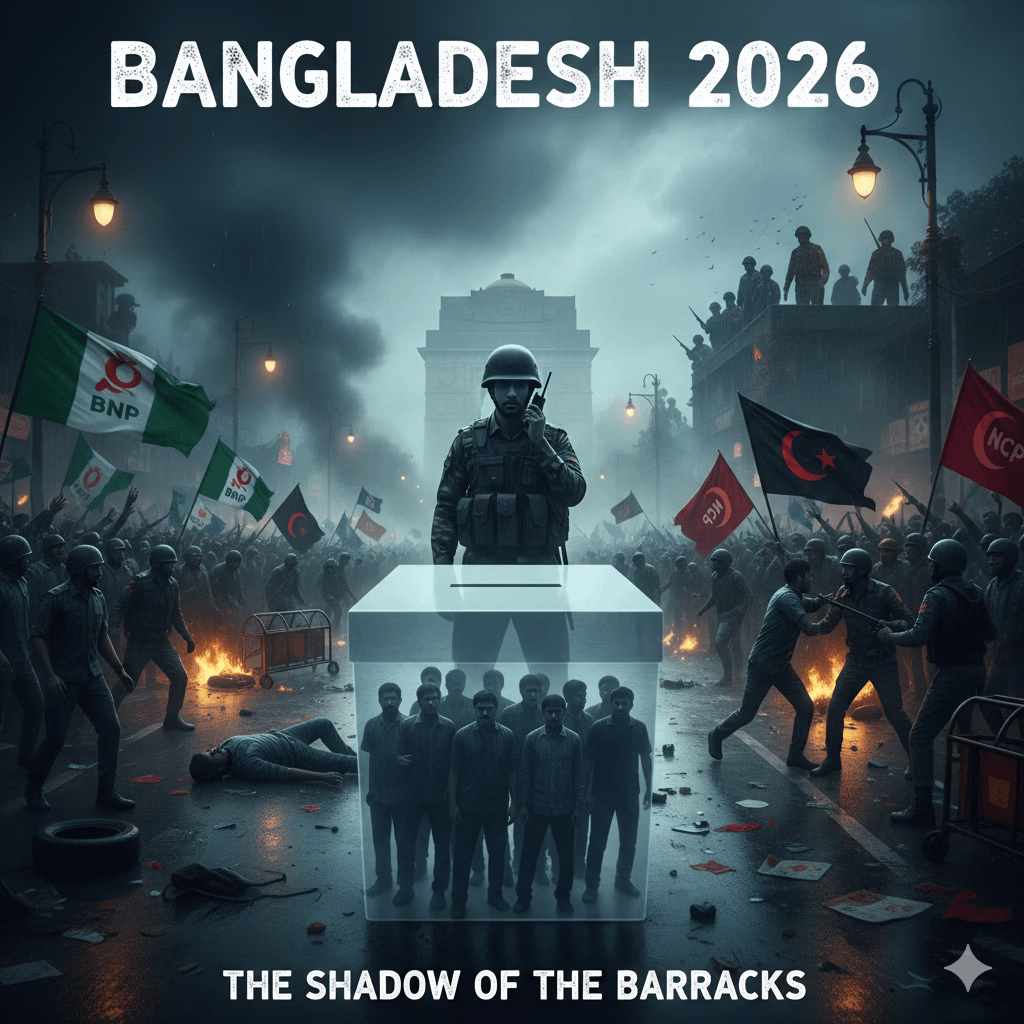
With the AL absent, the political theater has shifted to a bloody three-way confrontation. The Bangladesh Nationalist Party (BNP), led by Tarique Rahman — who returned from exile on December 25, 2025 — has moved to occupy the “centrist-liberal” vacuum left by the AL, attempting to appease international observers and India. Yet a new and volatile front has opened. In a desperate bid for survival, the student-led National Citizen Party (NCP) has formed a tactical alliance with Jamaat-e-Islami (JeI). This bloc is increasingly perceived as “ultra-ideological” and pro-Pakistan, creating a sharp contrast with the BNP’s pragmatic “Bangladesh First” stance. The rivalry has already turned violent. While authorities blame the Awami League and others point to the Yunus government, the assassination of youth leader Sharif Osman Hadi amid escalating NCP-Jamaat territorial battles suggests the deeper truth: the 2024 “unity” has dissolved into a raw struggle for power. From daily clashes over local extortion rights and territorial dominance to reports of mob violence and political intimidation, pre-poll tensions continue to escalate, adding to the volatility.
The Fizzling Spark
The NCP, once the darlings of the urban elite, is learning a harsh lesson in realpolitik. Their influence appears to be “fizzling out” as they struggle to move beyond Dhaka’s university campuses. The party has been rocked by high-profile resignations — including Dr. Tasnim Jara over the decision to align with Jamaat — amid broader internal dissent from 30 senior leaders. Without a rural grassroots network or the political “muscle” of the traditional parties, the student leaders risk becoming a historical footnote: revolutionary sparks that failed to build a sustainable fire.
The New Delhi Calculus
India’s stakes in Bangladesh remain existential. Recognizing that the AL horse is no longer in the race, New Delhi’s “deep state” has initiated a tactical thaw with Tarique Rahman. PM Modi’s recent outreach—including a personal letter conveyed by Foreign Minister Jaishankar on December 31, 2025, and follow-up meetings by the Indian High Commissioner in January 2026—signals a shift toward stability over ideology. India seeks to ensure that a BNP victory does not open the floodgates for anti-India militancy or a total takeover by pro-Pakistan elements like Jamaat. If a BNP government fails to stabilize the state or leans too heavily into “revenge politics,” India may quietly foster dissent among the silent majority to check the new regime’s power.
The Final Arbiter
The stage is set for a “Winner Takes All” victory on February 12, but the victory may be hollow. If the BNP wins with a weak mandate and enters a bloody street war with Jamaat and the NCP, the resulting chaos will reach a breaking point. History in Bangladesh is a circle. When civilian “democracy” descends into extortion and street-level anarchy, the military inevitably emerges as the “guardian of the state.” Given the current trajectory of fracturing alliances and rising violence, a military intervention or coup within 12 to 18 months of the election is not just a theory—it is a logical conclusion of the current political vacuum.