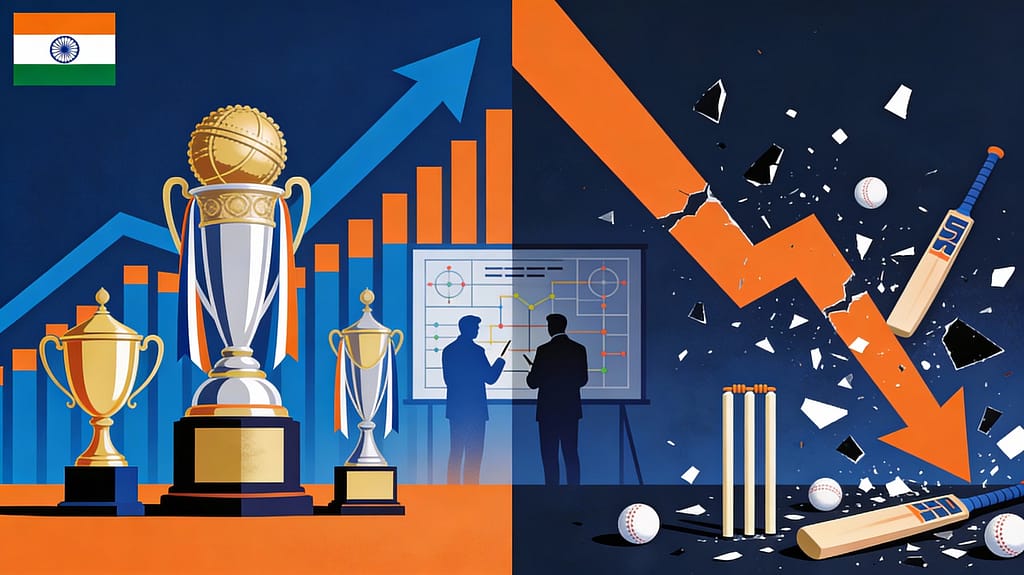

The Agarkar-Gambhir partnership inherited a well-oiled machine, a team fresh off a T20 World Cup victory and boasting a decade of near-unconquerable dominance at home. Yet, as we approach the January 4, 2026 selection meeting for the New Zealand series—effectively the final major act of Ajit Agarkar’s tenure before his contract expires in June—the legacy of this era appears to be defined by a restless urge to “fix” what was never broken. By treating a champion side like a struggling franchise in need of a rebuild, the management has not only dismantled India’s home fortress but has also risked the career trajectory of its brightest young talent, Shubman Gill.
The T20 Opening Debacle
The most glaring example of this mismanagement lies in the T20 opening slot. Before the current leadership decided to reimagine the lineup, India had discovered a potent weapon in the Sanju Samson and Abhishek Sharma partnership. This left-right combination provided a rare blend of aggression and rhythm, consistently propelling the team to explosive starts. By imposing Shubman Gill as the opener and vice-captain, the management broke this natural flow.
The numbers tell a painful story: with Samson-Abhishek opening together, India posted 200+ totals in six of twelve matches; after the forced transition to Gill as opener, that frequency plummeted to just one in thirteen games. The recent decision to drop Gill from the 2026 T20 World Cup squad is an implicit admission that this experiment was a blunder, but the damage of lost preparation time for specialists cannot be undone.
Test Cricket’s Laboratory Experiment
This pattern of unnecessary experimentation extended into the Test arena, specifically at the critical Number 3 position. Under Gautam Gambhir, this foundational spot was treated with the transience of an IPL scouting ground. By constantly shuffling players like Gill and Sai Sudharsan, the management stripped the top order of its psychological resilience. The result was a collapse of the Indian fortress, leading to two unprecedented home series losses—a 0-3 whitewash against New Zealand and a 0-2 defeat to South Africa. Under this regime, India’s Test win percentage has fallen to a dismal 36.8%, a staggering decline from the stability of the Dravid years.
The England Series Mirage
While supporters of the current regime point to the 2-2 draw in England as a success, a closer look reveals a statistical mirage. The 2025 England series, which produced over 7,000 runs and 19 centuries on historically flat pitches where even Washington Sundar scored a century, was played in conditions that masked fundamental team weaknesses. India’s 3,809 runs were the most ever scored by a team in a five-match series, but the team struggled to take twenty wickets consistently and lacked the clinical edge to win the series outright against a depleted English attack.
While Gill’s 754 runs were a feat of individual endurance, excluding these runs accumulated on unusually favorable tracks reveals a far more modest Test record, raising questions about whether his elevation across formats was premature. Had veterans like Rohit Sharma and Virat Kohli been part of that tour instead of being “transitioned” out, they would have undoubtedly thrived on those friendly conditions.
The Gill Casualty
Perhaps the greatest casualty of this “fix-it” mentality has been Shubman Gill himself. Pushed into three-format leadership roles and shifted across batting positions before he could master one, the toll on the young player has been immense. His recent neck injury—a serious disc bulge hitting the nerves that ruled him out of the Kolkata Test—came after months of non-stop cricket across all formats since February 2025. While injuries can happen to any player, the physical demands of being thrust into multiple roles simultaneously may have contributed to his body breaking down at a critical juncture.
A Legacy of Disruption
Gautam Gambhir and Ajit Agarkar set out to be disruptors, but in doing so, they disrupted India’s winning momentum. They inherited a team that knew how to win and turned it into a team constantly searching for its identity. As Agarkar prepares for his final major selection meeting on January 4th—with his tenure concluding in June 2026 after the T20 World Cup and before the Afghanistan series—the cricket world will see if the management has finally realized that innovation without stability is nothing more than chaos.