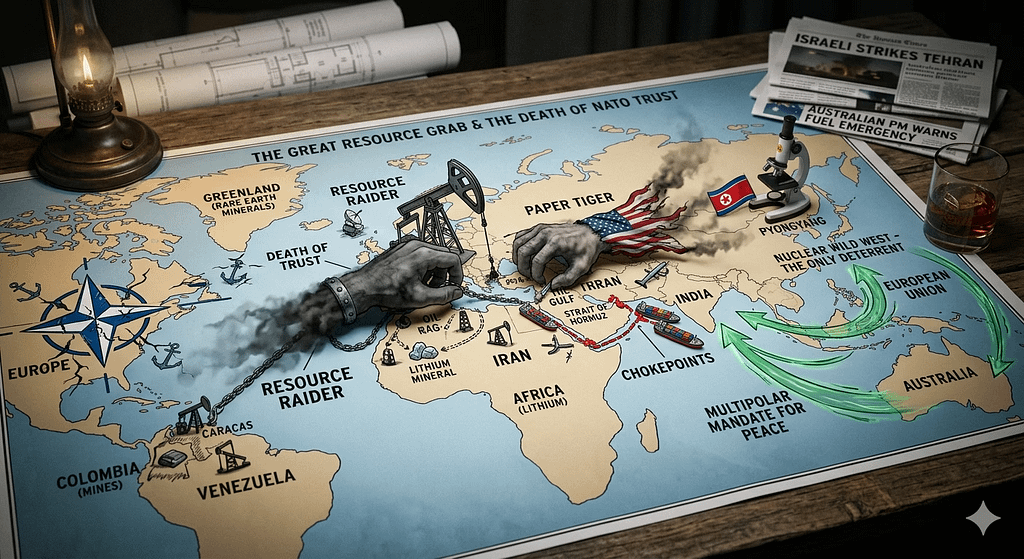

The world woke up this morning to a map that no longer makes sense, trapped in a geopolitical “Catch-22” that threatens to dismantle seventy years of global stability. On one side, we face the fundamentalist resolve of an Iranian regime poised to declare itself the undisputed Khalifa of the Islamic world. On the other, we see a Washington administration whose recent misadventures have exposed a startling truth: America is no longer a reliable superpower, but a transactional bully. This current escalation in Iran was birthed from a dangerous “false positive” in Caracas. The January removal of Nicolas Maduro was hailed as a triumph, yet it was a victory built on betrayal rather than strength. Maduro was extracted under the guise of being a “drug kingpin,” yet the moment he was gone, the “drug cartel” narrative vanished. In its place came American oil companies.
The truth is transparent; it was a successful kidnapping for crude. Emboldened by this, the administration has turned its sights on Iran, but the target list is growing into a global resource raid. We are witnessing a desperate scramble for the fuels and minerals of the future. Whether it is oil in the Middle East, rare earth minerals and uranium in the north, or lithium in the south, the U.S. has signaled that no sovereign resource is safe. This isn’t foreign policy; it’s a corporate liquidation of the planet’s assets. Yet, the most damning evidence of America’s lost credibility isn’t in the raids themselves, but in the silence from its allies. Spain has closed its airspace, and Italy has shuttered the Sigonella base to American combat operations. Europe has finally realized that the U.S. is an “unworthy partner,” and they are not alone.
For decades, the Gulf Nations rested their entire national security on the promise of American protection—a promise that was exposed as a fluke the moment Iranian missiles began raining down on Gulf infrastructure. If the most expensive military in history cannot protect its most vital energy partners from a mid-level conventional power like Iran, what value does the American “Security Umbrella” actually have? This failure has sent a clear message to Seoul, Tokyo, and Taipei: if Washington cannot secure a twenty-mile-wide strait like Hormuz, it certainly cannot stop a superpower like China. While Washington struggles with these defiant allies and failed promises, Iran has recognized its own leverage. By successfully choking the Strait of Hormuz and the Red Sea, Iran has proven it can paralyze the global economy.
If the U.S. retreats now—as has been hinted by leadership suggesting the war could end even without opening the Strait—Iran will emerge as the undisputed Badshah of Middle East oil. It will have successfully humiliated a superpower and proven that it, not America, dictates the cost of global survival. This victory will embolden a new Islamic hegemony, backed by the strategic silence and economic support of China and Russia. Perhaps the most dangerous legacy of this year, however, is the dark lesson being learned by every sovereign nation watching from the sidelines. Why does the U.S. attack conventional powers like Venezuela and Iran but negotiate with a nuclear-armed North Korea? The logic is now undeniable: nuclear weapons are the only true deterrent. As American credibility fades, we are entering a “Nuclear Wild West” where any nation with a lithium mine or an oil well is scrambling for a nuclear shield to avoid being “Maduro-ed.”
We are moving toward a world where nuclear weaponization is the only logical insurance policy for sovereignty, and the United Nations has proven itself a powerless relic in preventing this shift. We cannot wait for a paralyzed international body to act. The only path forward is an immediate, respectful ceasefire mediated by the world’s rising and established rational powers. India, Australia, and the European Union—nations with a direct stake in global trade and a tradition of the “middle path”—must step into the vacuum left by a bullying America and a fundamentalist Iran. We must move away from regime change for resources and toward a multipolar reality. If we don’t, we won’t just be counting the cost in barrels of oil; we’ll be counting the cost in the radioactive fragments of a shattered global order.