
Gold doesn’t move quietly without a reason.
And when it rises nearly 70% in a single year, as it did in 2025, markets are not speculating—they’re signaling concern.
This is not a routine inflation hedge.
This is not momentum trading.
The recent surge in gold prices reflects something deeper: a growing loss of confidence in the U.S. dollar and U.S. government debt as reliable store-of-value assets.
When Does Gold Typically Outperform?
Historically, gold tends to outperform during four broad conditions:
- Rising geopolitical risk
Wars, trade conflicts, and global instability increase demand for portable, non-sovereign wealth. - Falling real interest rates
Gold yields nothing. When real yields on cash and bonds decline, the opportunity cost of holding gold disappears. - High or accelerating inflation
Gold’s supply is fixed. Fiat money is not. - Loss of confidence in the dollar and U.S. debt
When the reserve currency is perceived to be weakening—or at risk of debasement—gold regains its role as the ultimate reserve asset.
Today, points 1 and 4 matter most.
Real interest rates remain relatively high by historical standards, and inflation—while sticky—is not surging. Yet gold is behaving as if something is deeply wrong.
That disconnect is the story.
This Is About Expectations, Not Current Conditions
Markets don’t price today.
They price what comes next.
The surge in gold is not reacting to current inflation or interest rates—it’s reacting to expected future policy choices. Specifically:
- A future with higher debt
- A political willingness to tolerate lower real rates
- A growing probability of debt monetization
- And ultimately, currency debasement
Gold rises when investors believe creditors will be repaid in cheaper money.
Geopolitics: Instability Has a Price
Global tensions have clearly escalated.
Trade wars, sanctions, resource conflicts, and territorial ambitions are no longer fringe risks—they are becoming baseline assumptions. When the probability of large-scale conflict rises, so does demand for assets that are:
- Portable
- Non-digital
- Outside the financial system
- Not tied to any single government
Gold checks every box.
Unlike fiat currencies, it can’t be printed.
Unlike crypto, it doesn’t rely on electricity, networks, or cybersecurity.
In worst-case scenarios—capital controls, war, forced migration—gold is still gold.
That alone explains part of the move.
The Dollar Problem: Trust Is Eroding
The more serious driver is confidence—or rather, the lack of it.
Recent U.S. policy choices have forced global investors to ask uncomfortable questions:
- Will U.S. debt ever be repaid in real terms?
- Are low rates being pushed to sustain fiscal math, not economic health?
- Is inflation quietly being accepted as the least painful way out?
Rising deficits, ballooning interest costs, political pressure on the Federal Reserve, and open comfort with monetary easing have made one thing clear:
Creditors are no longer confident that today’s dollars will hold tomorrow’s purchasing power.
When that happens, rational investors diversify.
The Evidence Is Already Visible
This loss of trust isn’t theoretical—it’s showing up across markets:
- Central banks are accelerating gold purchases
This is the loudest signal of all. Central banks don’t chase trends—they hedge regime shifts. - Long-term Treasury yields remain stubbornly high
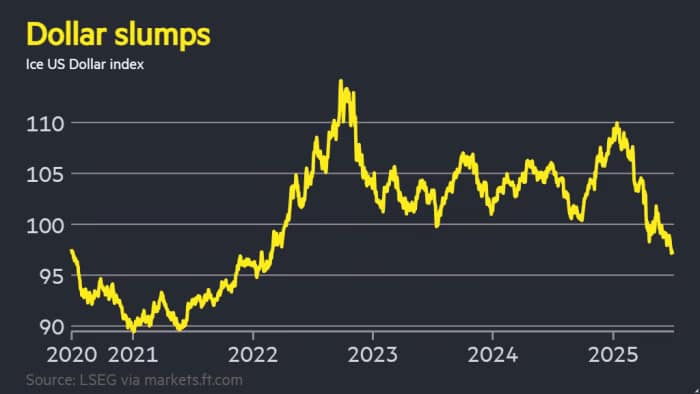
Even as short-term rates fall, 30-year yields are rising. Bond markets are demanding compensation for future inflation risk. - The dollar has weakened against major currencies
Despite still being the dominant reserve currency, its relative appeal is declining.
When the world’s safest borrower starts looking like a strategic debtor, creditors take notice.
Why Gold, Specifically?
Because there is no real alternative.
- The euro has structural flaws
- China’s capital controls limit trust
- Crypto is volatile and regulatory-dependent
Gold, for all its imperfections, remains the only globally trusted, politically neutral reserve asset.
When trust in the dollar weakens, gold doesn’t need to be perfect—it just needs to be less risky.
Final Thought: Trust Once Lost Is Hard to Rebuild
Reserve currencies don’t collapse overnight.
They erode slowly, then suddenly.
Gold’s price action suggests markets are quietly preparing for a world where:
- U.S. debt is managed through inflation
- Real yields stay suppressed
- Monetary discipline takes a back seat to political necessity
Gold isn’t predicting disaster.
It’s pricing realism.