
Introduction
Odisha is often described as a “resource-rich” state. It has minerals, ports, power generation capacity, and a steadily growing services sector. On paper, the fundamentals look strong. Bank deposits in Odisha have grown consistently over the years, indicating rising household savings, corporate balances, and institutional funds.
Yet when businesses and entrepreneurs in the state seek loans, a familiar complaint emerges: credit is hard to access.
This apparent contradiction is best explained through a simple but powerful banking metric — the Credit–Deposit (CD) Ratio.
Using official data published by the Reserve Bank of India, this article explains how Odisha’s money is mobilised locally but deployed elsewhere, why this happens, and why it quietly limits the state’s economic potential.
What Is Capital Leakage in Banking?
In banking terms, capital leakage occurs when deposits collected in one region are used to finance credit in another region.
Banks are not required to lend in the same geography where deposits are mobilised. Lending is recorded based on the place of sanction, not the place of deposit. This means a bank branch in Odisha can collect deposits, but the loan decision may be sanctioned from — and credited to — another state.
When this happens systematically, the deposit-rich region becomes a capital exporter.
The CD ratio captures this clearly:
CD Ratio = Total Credit ÷ Total Deposits
A low CD ratio means a large share of local savings is financing growth elsewhere.
Odisha’s Credit–Deposit Ratio: What the Data Shows
According to RBI’s Basic Statistical Returns of Scheduled Commercial Banks:
- 2015: 41.9%
- 2020: 39.5%
- 2025: 48.1%
There has been gradual improvement since 2020, but the structural gap remains significant.
In practical terms, this means:
For every ₹100 deposited in Odisha’s banks, only about ₹48 is lent within the state.
The remaining money does not sit idle. It is actively deployed — just not in Odisha.
Where Does Odisha’s Money Go?
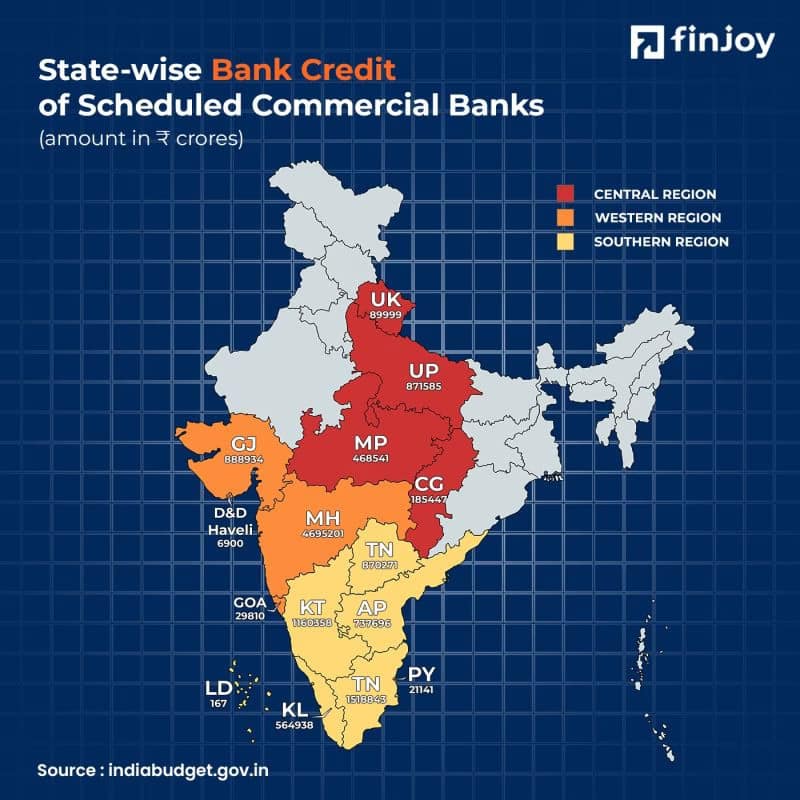
States with consistently high CD ratios include:
- Maharashtra
- Tamil Nadu
- Telangana
- Andhra Pradesh
- Karnataka
These states regularly absorb 90–150% of their deposits as credit, meaning they attract capital from other regions — including Odisha.
Banks prefer lending in these states because:
- Projects are larger and better structured
- MSMEs are more formalised
- Approval timelines are predictable
- Credit risk is easier to assess
This is not regional bias. It is a risk–return decision.
Why Odisha Becomes a Capital-Exporting State
Odisha’s low CD ratio is not caused by weak savings. In fact, deposits have grown steadily. The issue lies on the credit absorption side.
Key structural reasons include:
1. Limited Bank-Ready Enterprises
Many small and medium businesses in Odisha:
- Lack audited financial statements
- Have unstable cash flows
- Operate partially outside the formal system
This raises credit appraisal costs for banks.
2. Mining-Driven Deposits Without Local Lending
Mining and large industrial projects generate substantial deposits. However:
- Lending decisions are often taken at corporate headquarters outside Odisha
- Downstream manufacturing is limited
- Local supplier ecosystems remain thin
As a result, deposits stay, but credit leaves.
3. Project Execution Risk
Delays related to land acquisition, approvals, and infrastructure increase uncertainty. Banks price this uncertainty by lending conservatively or shifting credit elsewhere.
Why Capital Leakage Matters More Than It Appears
A persistently low CD ratio has long-term consequences:
- Slower industrial diversification
- Fewer private-sector jobs
- Weak MSME growth
- Higher dependence on government spending
Even when state revenues grow, the multiplier effect of private credit remains muted.
In contrast, states with high CD ratios experience faster, self-reinforcing growth driven by private investment.
The Bigger Picture
Odisha does not suffer from a shortage of money.
It suffers from a shortage of deployable, bank-ready opportunities.
Capital leakage is not a conspiracy by banks. It is a signal — one that reflects deeper institutional and policy gaps.
Understanding this is the first step toward fixing it.
👉 In Part 2, we examine why banks hesitate to lend more in Odisha — and why the explanation has more to do with risk mechanics than regional neglect.