
In the noisy arena of modern politics, there is a persistent myth that the general public is merely a canvas for digital propaganda, street might, and foreign-backed narratives. We are told that campaigns win hearts and slogans win minds, yet history—especially across the volatile landscape of South Asia—keeps proving the opposite. There exists a “Silent Majority” that is far wiser than the architects of political engineering. They are quiet evaluators who speak only once every few years, but when they finally do, the collective wisdom of the people has a way of shattering the hubris of the powerful.
We saw this clearly in India’s 2024 General Elections. The ruling party marched forward with the confident cry of ‘Ab ki baar 400 paar’, but the Indian voter held up a mirror instead. They didn’t dismantle the government, but they pruned its overconfidence, denying the BJP a solo majority and keeping the alliance to a humble simple majority. Simultaneously, the public saw through the opportunistic nature of the opposition’s alarmist claims about the Constitution. The voter refused to be fooled by either side’s extremes, choosing a middle path that favored stability over arrogance.
The phenomenon in Pakistan was even more stark. Despite the state’s massive effort to dismantle Imran Khan and his Tehreek-e-Insaf (PTI)—stripping them of their symbol, banning their rallies, and incarcerating their leadership—the silent majority spoke through their ink-stained fingers. They gave an undeniable moral mandate to PTI-backed candidates. Even if the corridors of power were eventually filled by a different coalition through backroom deals and military backing, the message was absolute: you can ban a party, but you cannot ban a people’s preference.
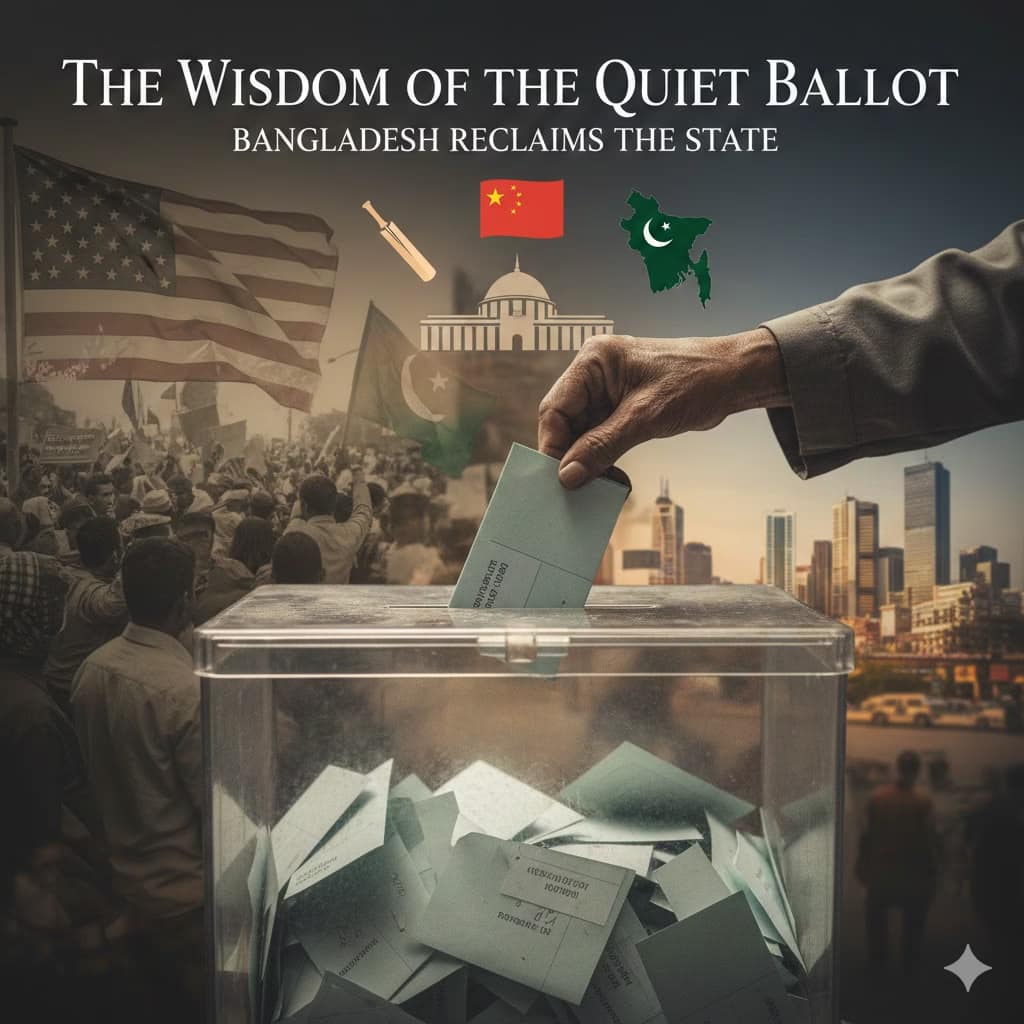
Now, we witness this narrative’s most recent chapter in Dhaka. Following the February 12, 2026 elections, the Bangladesh Nationalist Party (BNP) has secured a massive two-thirds majority. While the international press focuses on the “return of the BNP,” the real story is the rejection of the “July Revolution’s” radical edges. The world heard the screams of the 2024 protests, but it ignored the silence of the average Bangladeshi household. While foreign powers and student leaders celebrated the collapse of the Hasina regime as a triumph of “street might,” the silent majority watched the ensuing months of instability with growing unease. They saw the breakdown of law, the communal tensions, and an attempt to rewrite the national identity on purely emotional grounds.
Perhaps the most fascinating display of ballot-box wisdom was the rise of the Jamaat-e-Islami as the primary opposition. In a healthy democracy, the public instinctively seeks a system of checks and balances; they rarely hand over the keys to the kingdom without ensuring someone is watching the door. Because the Awami League was banned and erased from the ballot, the voters were robbed of their traditional counter-weight. Had the Awami League been present, they likely would have been the ones tasked with keeping the government in check. In their absence, the silent majority made a cold, pragmatic calculation. Although people largely reject the extremist views of the Jamaat, they felt they had to create an opposition. They elevated the Jamaat to 68 seats (77 for their alliance) not out of a sudden love for their radical ideology, but out of a democratic compulsion to ensure the BNP did not govern without oversight.
This same pragmatism is why the student-led National Citizen Party (NCP) was largely rejected, winning only a handful of seats. The public realized that while the revolutionaries were good at protests, they weren’t yet trusted with the treasury. By choosing the BNP as the leaders and the Jamaat as the monitors, the public effectively bypassed the “India Out” hysteria and the “pro-Pakistan” emotionalism that had gripped the interim administration. They chose predictability over a leap into the radical unknown.
Democracy is often called a “lesser evil,” a format that is rarely ideal but remains better than any alternative. It is the silent majority that finally wins back the State from both the autocrat and the mob. The 2026 Bangladesh election shows that the “real masters” can see through the fog of conspiracy to restore order. Whether in New Delhi, Islamabad, or Dhaka, the message is the same: we should take pride in the collective wisdom of the people, for it remains the only tool powerful enough to reclaim a nation’s voice and correct its course.