
Introduction: The Question Odisha Must Confront
Odisha is not a poor state.
It is a capital-surplus state.
Households save. Corporates deposit. Public sector units park funds. Yet industries complain of credit shortages, MSMEs struggle to scale, and private investment remains shallow outside a few pockets.
The missing link lies in a single banking metric that quietly determines the economic fate of Indian states — the Credit–Deposit (CD) Ratio.
Using official data published by the Reserve Bank of India, this pillar page explains:
- Why Odisha exports capital to other states
- How high-performing states absorb 100%+ credit
- Why district-level credit gaps persist
- What Odisha must do to reverse the trend by 2030
This page serves as the master explainer, linking to five detailed deep-dives.
What Is the Credit–Deposit Ratio (In Plain Terms)?
The Credit–Deposit ratio measures how much of the deposits collected by banks are lent out as credit within the same geography, based on the place of sanction.
CD Ratio = Total Credit ÷ Total Deposits
How to read it:
- <50% → Capital-exporting region
- 60–80% → Balanced growth
- 90%+ → Capital-attracting growth hub
A low CD ratio does not mean banks lack money.
It means money is being deployed elsewhere.
Odisha’s CD Ratio: The Long-Term Picture (2015–2025)
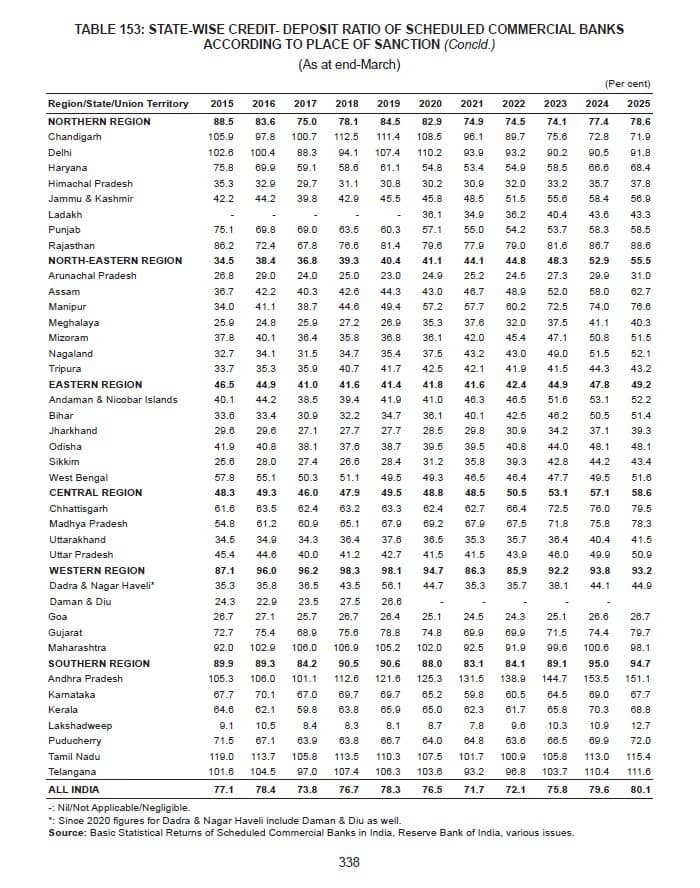
From RBI’s Basic Statistical Returns of Scheduled Commercial Banks, Odisha’s CD ratio trend is as follows:
- 2015: 41.9%
- 2018: 37.6%
- 2020: 39.5%
- 2023: 44.0%
- 2025: 48.1%
Yes, there is improvement.
But structurally, Odisha remains far below the national average (80.1% in 2025).
Visual Proof: Odisha vs High-Absorption States
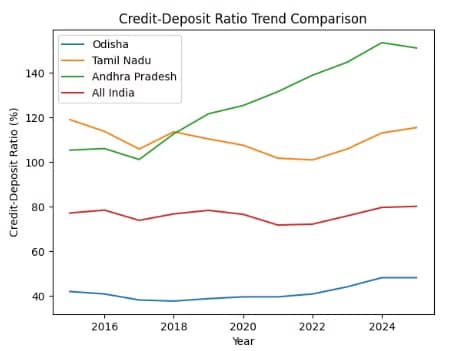
The graph below compares Odisha with Tamil Nadu, Andhra Pradesh, and All-India averages using RBI data.
📊 Credit–Deposit Ratio Trend (2015–2025)
- Odisha remains under 50%
- Tamil Nadu consistently stays above 100%
- Andhra Pradesh accelerates beyond 150%
- All-India average trends around 75–80%
👉 This gap is not cyclical. It is structural.
Where Does Odisha’s Money Go?
States with consistently high CD ratios include:
- Maharashtra
- Tamil Nadu
- Andhra Pradesh
- Telangana
- Karnataka
These states:
- Absorb more credit than they deposit
- Attract capital from low-CD states
- Use banking credit as a growth multiplier
Odisha’s deposits are quietly financing factories, MSMEs, and jobs elsewhere.
Why This Happens (High-Level Summary)
Banks do not lend emotionally.
They lend where risk is predictable.
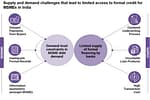
Odisha’s challenge is not savings — it is credit absorption capacity:
- Fewer bank-ready MSMEs
- Limited downstream manufacturing
- Project execution delays
- Weak district-level credit ecosystems
This is explained in depth in the individual parts below.
🔗 The Explainer Series (Read in Order)
Part 1: Odisha’s Capital Leakage Problem
Explains how deposits mobilised in Odisha are sanctioned as credit in other states.
https://bnacharya.com/odisha-capital-leakage-credit-deposit-ratio-explained/
Part 2: Why Banks Don’t Lend Enough in Odisha
Breaks the myth of bias and explains lending through a banker’s risk lens.
https://bnacharya.com/why-banks-dont-lend-enough-in-odisha/
Part 3: How Southern States Absorb 100%+ Credit
Shows how Andhra Pradesh and Tamil Nadu engineered high CD ratios.
https://bnacharya.com/how-southern-states-absorb-more-credit-than-odisha/
Part 4: District-Level Credit Gaps in Odisha
Explains why credit concentrates in a few districts and bypasses others.
https://bnacharya.com/district-level-credit-gaps-in-odisha-explained/
Part 5: Odisha’s Roadmap to a 65% CD Ratio by 2030
A practical, low-risk plan to reverse capital leakage.
https://bnacharya.com/odisha-credit-deposit-ratio-roadmap-2030/
What the RBI Data Clearly Tells Us
Based on the official RBI table (Table 153):
- Odisha is below Eastern Region average
- Even Bihar has overtaken Odisha in CD ratio
- Southern states have structurally decoupled from deposit dependence
- All-India CD ratio is rising faster than Odisha’s
📄 Primary RBI Source (PDF)
https://rbidocs.rbi.org.in/rdocs/Publications/PDFs/153T_111220255DEA2A2D23744132BFEDD5768D038648.PDF
This is not anecdotal.
This is central-bank-validated evidence.
Why This Matters for Odisha’s Future
A persistently low CD ratio leads to:
- Slower private investment
- MSME stagnation
- Job creation outside the state
- Over-reliance on government capex
States with high CD ratios grow faster and more autonomously.
The Strategic Shift Odisha Needs
From:
“We mobilise deposits well”
To:
“We absorb and multiply capital locally”
This requires:
- Bank-ready enterprises
- Risk-sharing frameworks
- District-level accountability
- Credit-focused governance
Final Takeaway
Odisha’s growth challenge is not about money.
It is about where that money works.
Fix credit absorption — and the rest follows.
This pillar page, backed by RBI data, exists to make that invisible truth visible.